On: A Category Marvel

On did not start with a branding exercise or a consumer trend. It started in the late 2000s with a retired athlete who felt that running shoes could get a whole lot better.
Olivier Bernhard had spent the better part of the early 2000s as a professional triathlete and duathlete, winning world championships and logging thousands of miles on the road. By the time he stepped away from competition, the performance shoe market had settled into a familiar rhythm. Brands competed on cushioning compounds, weight reductions, and material tweaks, but the core experience of running had barely shifted in years. Shoes were getting lighter. Foams were getting softer. But the sensation underfoot remained largely unchanged.
Bernhard believed the problem was not impact absorption, which most modern shoes handled well enough, but what happened immediately after. The transition from landing to push-off felt inefficient. Energy went into the ground and stayed there, so running still felt like absorbing force rather than redirecting it forward.
After retiring, Bernhard began experimenting on his own. Around the mid-to-late 2000s, some of his earliest prototypes involved modifying existing shoes by gluing pieces of rubber hose to the soles. The goal was to test whether segmented cushioning could compress vertically on impact and then rebound during toe-off while remaining stable horizontally. The prototypes looked absurd, but they produced a noticeably different feel that was enough to validate the concept.
Bernhard was convinced there was something there but didn't feel confident enough with his current skill set to go at this alone. He understood performance but not footwear manufacturing at scale, brand-building, or distribution. If the idea was going to survive beyond experimentation, it would need structure.
That structure arrived in 2010, when Bernhard connected with David Allemann and Caspar Coppetti, two Swiss entrepreneurs with experience in marketing, sales, and building consumer businesses. Bernhard brought performance credibility and product intuition. Allemann and Coppetti brought operational capabilities. Together they could bring to market a technology called CloudTec.
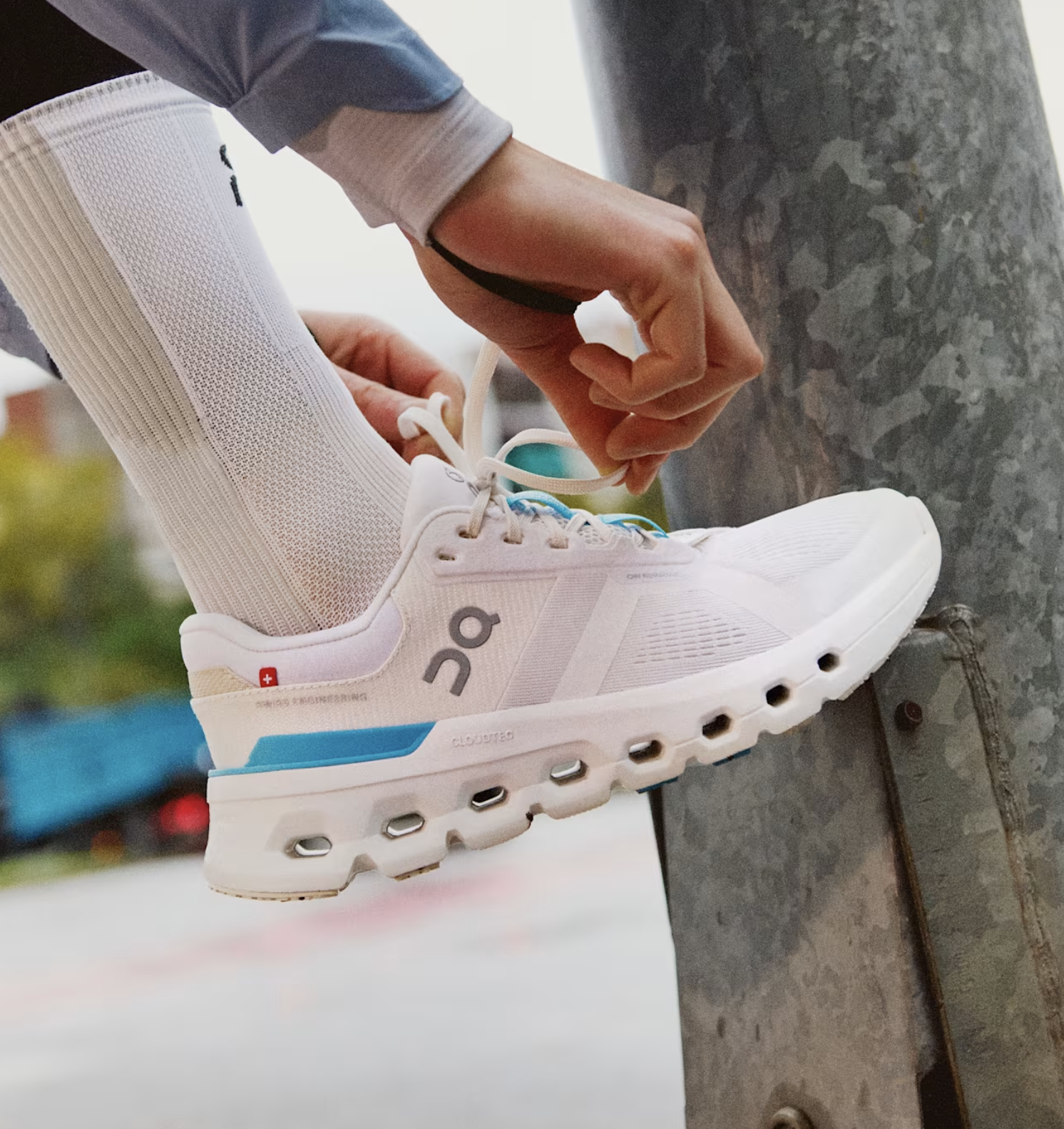
In the early years following the company’s formation, roughly between 2010 and 2012, the team made a conscious decision not to chase scale. They did not attempt to compete with established footwear companies on distribution reach or marketing spend. Instead, they focused on credibility within the running community. Early On shoes were designed to feel unmistakably different, but the visual differences of the fragmented sole communicated differentiation before the customer even tried the shoe on.
The first meaningful validation came through specialty running stores in the early 2010s. These shops serve serious runners and act as informal gatekeepers of trust within the sport. On invested heavily in education at the retail level, encouraging store staff to run in the shoes, understand the mechanics, and explain the technology clearly. This approach slowed expansion, but this ensured brand equity.
Runners soon noticed the value proposition. The shoes felt soft on landing and firm during acceleration, particularly at moderate to faster paces. They did not replace every shoe in a runner’s rotation, but they earned a specific role within it. This was a start.
As demand increased across Europe between 2013 and 2016, On resisted pressure to broaden its product line too quickly. Development remained tightly controlled. Rather than abandoning CloudTec for trend-driven redesigns, the company refined it incrementally. On did not chase maximal cushioning or extreme minimalism as those trends cycled through the industry. Its shoes occupied a deliberate middle ground, appealing to runners who valued efficiency, rhythm, and feel over spectacle.
By the mid-2010s, On’s visual brand language had taken shape: clean silhouettes, muted color palettes, minimal copy, and a distinctly Swiss sense of restraint. The brand presented itself as technical but accessible. That positioning allowed On to attract both committed runners and a broader audience that appreciated comfort and design without needing performance theatrics.
The company’s next inflection point came as it expanded into the United States around 2016. Once again, On prioritized specialty retailers over mass-market exposure. Growth was slower than it could have been, but the brand avoided dilution.
As the decade progressed, usage began to expand beyond training. By the late 2010s, On shoes were appearing in everyday settings, worn by people who valued comfort and understated design. The company neither resisted nor aggressively pursued this shift, reenforcing the Swiss sense of restraint in their brand.
A defining strategic moment arrived in 2019, when On partnered with Roger Federer, a professional tennis icon. The relationship went beyond a traditional endorsement. Federer became a long-term partner and investor, contributing to product development and brand direction. The collaboration signaled that On was aligning itself with longevity, precision, and sustained excellence rather than hype or youth culture. Federer’s involvement reinforced the brand’s equity.

Behind the scenes, the company continued to professionalize. Between 2018 and 2021, On strengthened its supply chain, expanded direct-to-consumer operations alongside wholesale, and introduced apparel carefully, without shifting focus away from footwear.
Expanding Vs Branding
Product expansion tests brand equity more than initial success ever does. When a company introduces new products, each one becomes a new touchpoint that either reinforces or erodes what customers believe the brand stands for. A single weak product can undo years of trust because customers do not evaluate products in isolation. They evaluate the brand as a system. Quality signals compound. If the first purchase performs well, customers return. If the second disappoints, confidence collapses. Maintaining brand equity requires consistency across the entire product line, not occasional excellence. Avoiding dilution means ensuring that every new product meets or exceeds the standard set by the original offering, because repeat purchases and referrals are driven less by novelty and more by the reliability of experience.
When On went public in 2021, it entered the market with a clearly defined position. It was not competing on price or volume, and it was not optimized for trend velocity. It offered a specific running experience while also serving the larger daily shoe audience.
On’s growth was not the result of viral moments or sudden consumer shifts. It was built through product differentiation, disciplined distribution, and a sustained commitment to a single idea. The company stayed true to its brand identity, and in return, as its brand equity grew, so did its valuations.
In an industry dominated by incremental change, On built a business by focusing on sensation as much as specification. That insistence turned an absurd prototype built into a real category competitor.
Works Cited
- On Holding AG. “CloudTec® Explained.” Technical overview of On’s sole design philosophy and performance differentiation.https://www.on.com/en-us/technology
- Forbes. “How On Running Became One of the Fastest-Growing Shoe Brands in the World.” Coverage of On’s founding, specialty retail strategy, and expansion.https://www.forbes.com/sites/
- Harvard Business School Case Study. “On Running: Scaling a Premium Performance Brand.” Analysis of On’s early market positioning, distribution discipline, and growth strategy.https://www.hbs.edu/faculty/Pages/item.aspx
- Fast Company. “Why On Running’s Shoes Look So Different.” Discussion of CloudTec, product-led differentiation, and brand identity.https://www.fastcompany.com/
- Bloomberg. “On Holding IPO Signals Strength of Performance Footwear Market.” Coverage of On’s public offering and business fundamentals.https://www.bloomberg.com/
- CNBC. “Roger Federer Invests in Swiss Running Shoe Brand On.” Reporting on Federer’s partnership, equity stake, and strategic role.https://www.cnbc.com/
- Financial Times. “On Running’s Rise from Swiss Startup to Global Footwear Brand.” Business analysis of On’s growth, capital strategy, and competitive positioning.https://www.ft.com/